

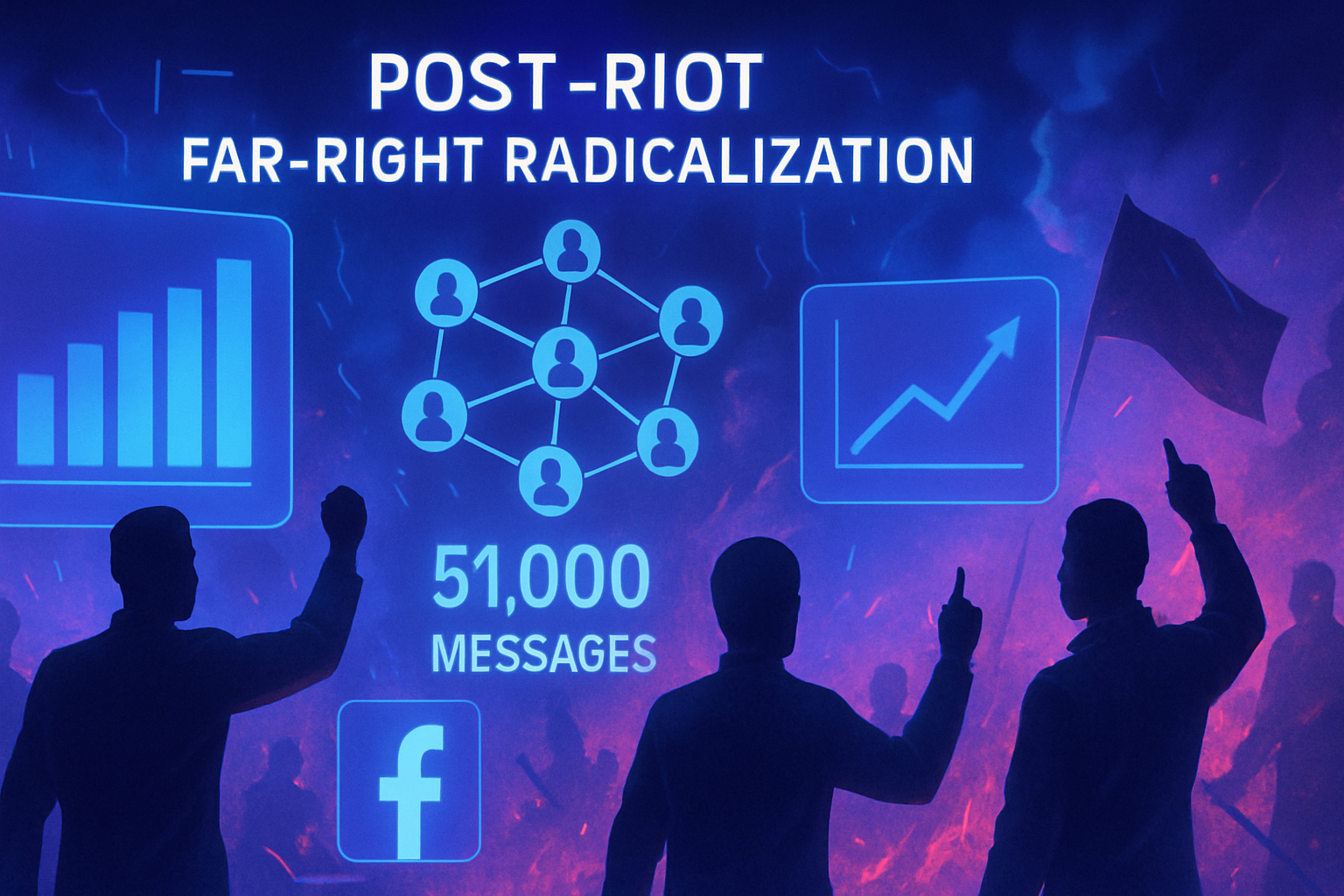
The troubling rise of the far right is revealed through our observations of post-riot publications. A rigorous analysis of 51,000 messages on Facebook uncovers the entanglement of radicalized discourses. In the face of these information streams, it is necessary to understand how radicalization nourishes a vibrant ecosystem, where distrust of institutions is deeply rooted. The research reveals interconnected networks, where manipulations and false assertions intertwine, shaping opinions. The quest for truth regarding these socio-political dynamics appears of paramount urgency for our modern society.
Analysis of post-riot publications
Currently, over 1,100 individuals are facing charges related to the summer 2024 riots. A limited number of them have been prosecuted for offenses arising from their online activity. Prison sentences, ranging from 12 weeks to 7 years, have sparked fierce criticism on social media. The individuals behind the publications have often been portrayed as defenders of free speech, while their messages are minimized and relegated to mere provocations.
The incriminating publications were disseminated on popular social media platforms such as X, Instagram, and Facebook, and not on networks more commonly associated with the far right. Although most messages were shared on personal pages, some posted in public groups reinforced a sense of belonging and validation within online communities.
Mapping online groups
The investigation focused on identifying Facebook groups frequented by the accused individuals. Three groups were selected for their direct link with members charged with online offenses or who expressed support for the rioters. Connections with thirteen other groups, the majority of which are also public, were highlighted. All these groups share moderators, contributing to a certain uniformity in exchanges.
Role of moderators and administrators
Moderators play an essential role. They approve membership requests, issue bans, and supervise content. Administrators have additional privileges, such as adjusting group settings and adding new moderators.
Categorization of shared content
The analysis focused on the typology of messages. Researchers examined a total of 123,000 publications generated from the creation of the groups until May 2025, establishing that 51,000 of them contained right-wing extremist content. An in-depth categorization shed light on themes such as anti-immigration, nativism, and identity denial.
Use of AI tools for categorization
The classification method was sophisticated, integrating artificial intelligence tools. These allowed cross-referencing of human analysis results with those from the AI model, thereby enhancing the reliability of the results. The model’s performance, evaluated by statisticians, confirmed its robustness compared to similar academic studies, achieving an accuracy rate of 94.7%.
A community mired in distrust
Within the groups studied, an ecosystem has developed. Members share a sense of distrust toward the government and its institutions. These individuals, often disillusioned, exchange ideas shaped by deep grievances regarding their place in society. They express a conviction that their freedom of speech is threatened, which fuels their anger and frustration.
The mechanisms of spreading extreme ideas alarmingly strengthen within this online environment. The virality of disinformation fosters the entrenchment of xenophobic sentiments and conspiracy theories, illustrating the rise of a troubling radicalization movement. Articles such as the growing use of AI in scams emphasize the importance of this battle against disinformation.
Analysis of individual perceptions
Individuals participating in these online forums navigate between real concerns and deeply rooted ideologies. The social divide seems to connect to these networks, where emotional support and gradual radicalization intertwine. Publications disseminating racial hate accumulate, fueling increasingly concerning echoes among group members.
The spiral of interactions in these communities transcends mere discussion; it aims to normalize hate speech under the guise of personal opinions. This dynamic highlights the need for increased vigilance and a deep analysis of the disinformation mechanisms that prevail in unusual spaces accessible to a wide audience, as demonstrated by recent articles on social media treatment.
The spread of far-right ideology thus represents a major challenge in the contemporary media landscape, affecting not only the public sphere but also the collective perception of democratic values. The exploration of this radicalization necessitates sustained attention, given its impact on society. The analysis of posts oriented towards the far right deserves thorough investigation with insights from experts in the field, as addressed by Giuliano da Empoli in his works.
Frequently asked questions about the analysis of post-riot publications
What was the primary goal of the analysis of the 51,000 post-riot publications?
The primary goal was to understand how online communities mobilized around the summer 2024 riots and to explore the themes of far-right radicalization that emerged in the publications on Facebook.
How did you select the publications for this analysis?
The publications were selected from three public Facebook groups containing members charged in connection with the riots, capturing all textual content shared from the creation of the groups until May 2025.
What categories of content did you identify during the analysis of the messages?
We identified several categories of content, including anti-establishment, anti-immigration, demonization of migrants, nativism, and right-wing identity/existence.
How did you verify the reliability of the results obtained from your analysis?
The reliability was verified by comparisons with human evaluators, achieving 93% agreement between the judgments of the AI tool and those of the annotators.
What tools did you use to classify the publications on Facebook?
We used ChatGPT 4.1 via the OpenAI API to classify the publications based on keywords and phrases indicating radicalization.
What was the total volume of analyzed publications, and how was it reduced?
We initially analyzed 123,000 publications, but the final classification focused on 51,000 textual messages due to the stringent nature of our categorization process.
How does Facebook group moderation influence the type of content shared?
Moderators and administrators play a key role in managing posts, helping to create an environment where certain types of content, including far-right content, are normalized and shared.
How are the results of your analysis used to understand online far-right radicalization?
The results provide insights into the social dynamics and narratives that encourage radicalization, allowing researchers and policymakers to develop strategies to counter online extremism.
What challenges did you encounter while analyzing this type of online content?
Challenges include the potential misclassification of certain messages and the need to ensure that the categorization process is rigorous and transparent.