

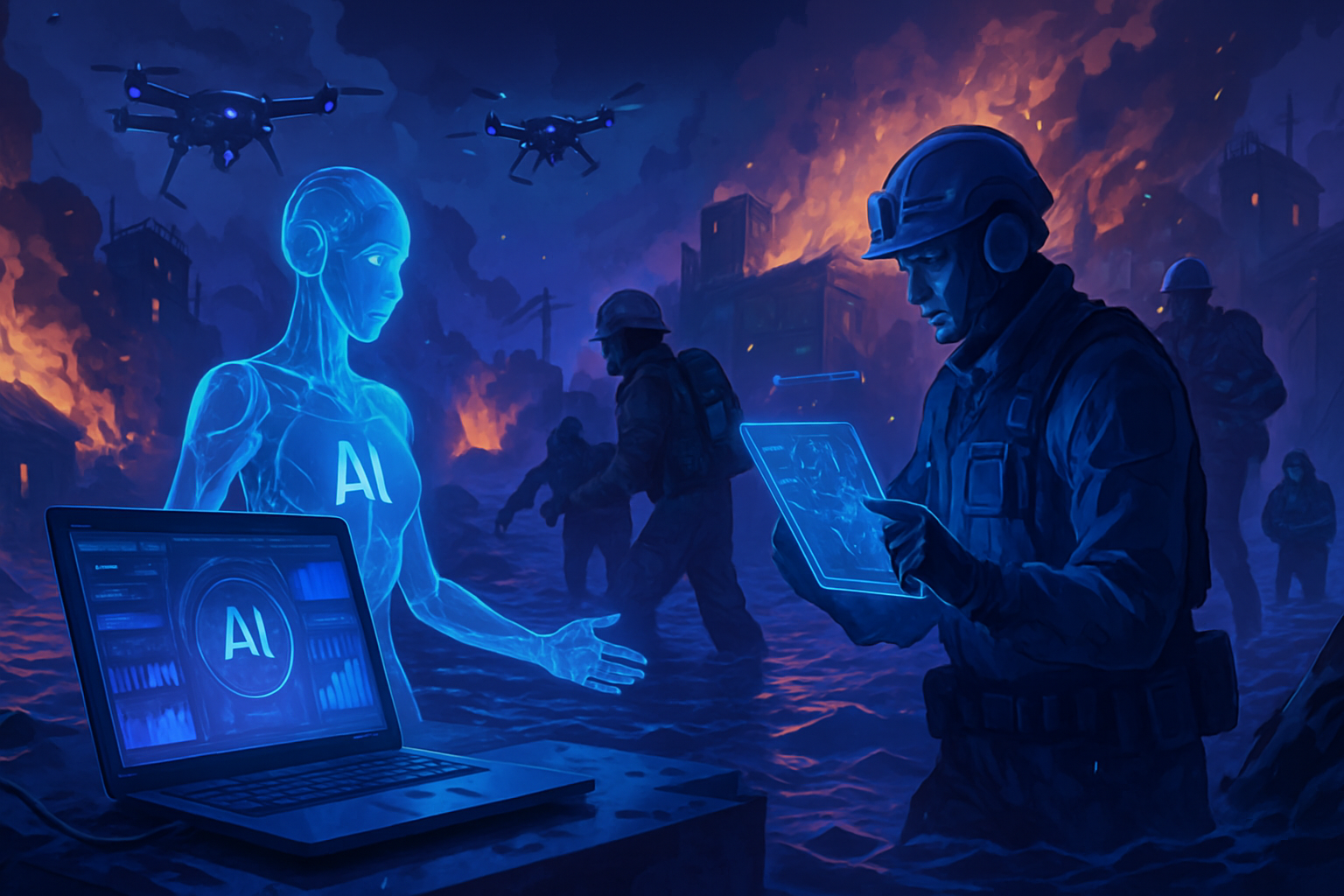
Artificial intelligence is radically transforming decision-making mechanisms in disaster response. Speed of intervention is essential when every second counts to save lives and restore order. In the face of chaotic scenarios, the need for wise choices becomes paramount, requiring a subtle balance between automation and ethics.
Autonomous systems and sophisticated algorithms offer unprecedented perspectives for directing resources in real-time, minimizing human errors. The synergy between humans and machines promises efficiency and resilience, thus redefining the landscape of crisis management.
Technological revolution in disaster management
In emergency situations, decision speed is essential for saving lives and managing resources. Thanks to the rapid advances in artificial intelligence (AI), autonomous systems are redefining how rescue teams approach crises. Recent research, including studies from Cranfield University, has focused on a structured decision-making framework that optimizes choices in disaster management.
Structured decision-making framework
The framework proposed by the research team has demonstrated superiority in decision accuracy compared to human operators. Indeed, results indicate that AI can surpass human decision-making with a precision exceeding 39%. This development occurs in a context where the risks of errors are particularly critical.
Benefits and ethical challenges
While AI provides improved response times, researchers emphasize the need for rigorous ethical oversight. The balance between the benefits of automation and the safety of decisions poses a crucial challenge. The work of Cranfield University aims to ensure that the use of AI in this field is transparent and responsible.
Research objectives
In this context, researchers have focused on three fundamental areas. First, the design of an innovative framework for autonomous decision-making in scenarios where safety is paramount. Next, the development of an AI agent capable of improving its choices in crisis situations. Finally, a human evaluation study has been conducted to validate the effectiveness of this agent.
Stability and predictability in decisions
The structured AI framework has shown 60% greater stability in decision accuracy. This gain in precision allows for more predictable outcomes than those produced by systems based on human judgment. Such efficiency could indeed change the game in emergency interventions.
Concrete applications in crisis management
The results of this research could have significant repercussions in the field of disaster response. By integrating AI algorithms into operations, crisis responses can become not only faster but also more effective. This could lead to a more optimal management of resources, thereby facilitating the rehabilitation of affected areas.
Continuous innovation and vigilance
As AI continues to assert itself, voices are raised about the need to master this tool without becoming reliant on it. Warnings from certain figures, such as Mylène Farmer, remind us of the precautions to take in the face of potential dangers. Staying in control of AI avoids falling into the pitfalls of clumsy use that could lead to harmful biases.
Future perspectives
The proposed decision framework from Cranfield University paves the way for a responsible use of AI in emergency situations. Ongoing research promises increasingly effective solutions to confront disasters. In this context, keeping up with developments in the field of artificial intelligence technologies remains essential to anticipate and understand the impact of these innovations.
For more information, check out the full article on TechXplore.
Frequently asked questions about Artificial Intelligence in disaster response
How does artificial intelligence improve decision-making in disaster situations?
Artificial intelligence enables rapid data analysis, providing immediate insights that help guide emergency responses, while reducing human errors and increasing decision accuracy.
What AI technologies are used in disaster management?
The technologies include data analysis systems, autonomous drones, unmanned aerial vehicles (UAVs), as well as satellite imaging tools that facilitate real-time data collection and interpretation.
What advantages does AI offer over human decision-making in emergency situations?
AI can process vast amounts of data quickly and without bias, allowing it to provide more accurate and consistent recommendations in situations where time and precision are crucial.
What risks are associated with the use of AI in emergency situations?
Risks include potential errors due to algorithmic biases, excessive dependence on technology, and the challenge of ensuring that AI is used ethically and transparently.
How can relief agencies integrate AI into their operations?
Agencies can adopt a phased approach by integrating AI systems for predictive analysis, resource management, and real-time communication while training their personnel on the capabilities and limitations of AI.
What is the impact of AI on the speed of disaster response interventions?
The introduction of AI can significantly reduce the time needed to develop response strategies, allowing rescue teams to act more quickly and effectively on the ground.
Can AI systems operate autonomously in emergency situations?
Yes, some AI systems are designed to operate autonomously and make real-time decisions, but their effectiveness depends on the quality of the data available and their decision architecture.
How is the effectiveness of AI systems measured in emergency situations?
Effectiveness is measured by the accuracy of decisions made, the speed of responses, and the ability to generate positive outcomes in varied scenarios, often compared to traditional human interventions.
What training is necessary for operators working with AI systems in emergency situations?
Operators need training on AI technologies, data handling, as well as on ethical aspects and best practices to maximize the effectiveness and safety of emergency interventions.