


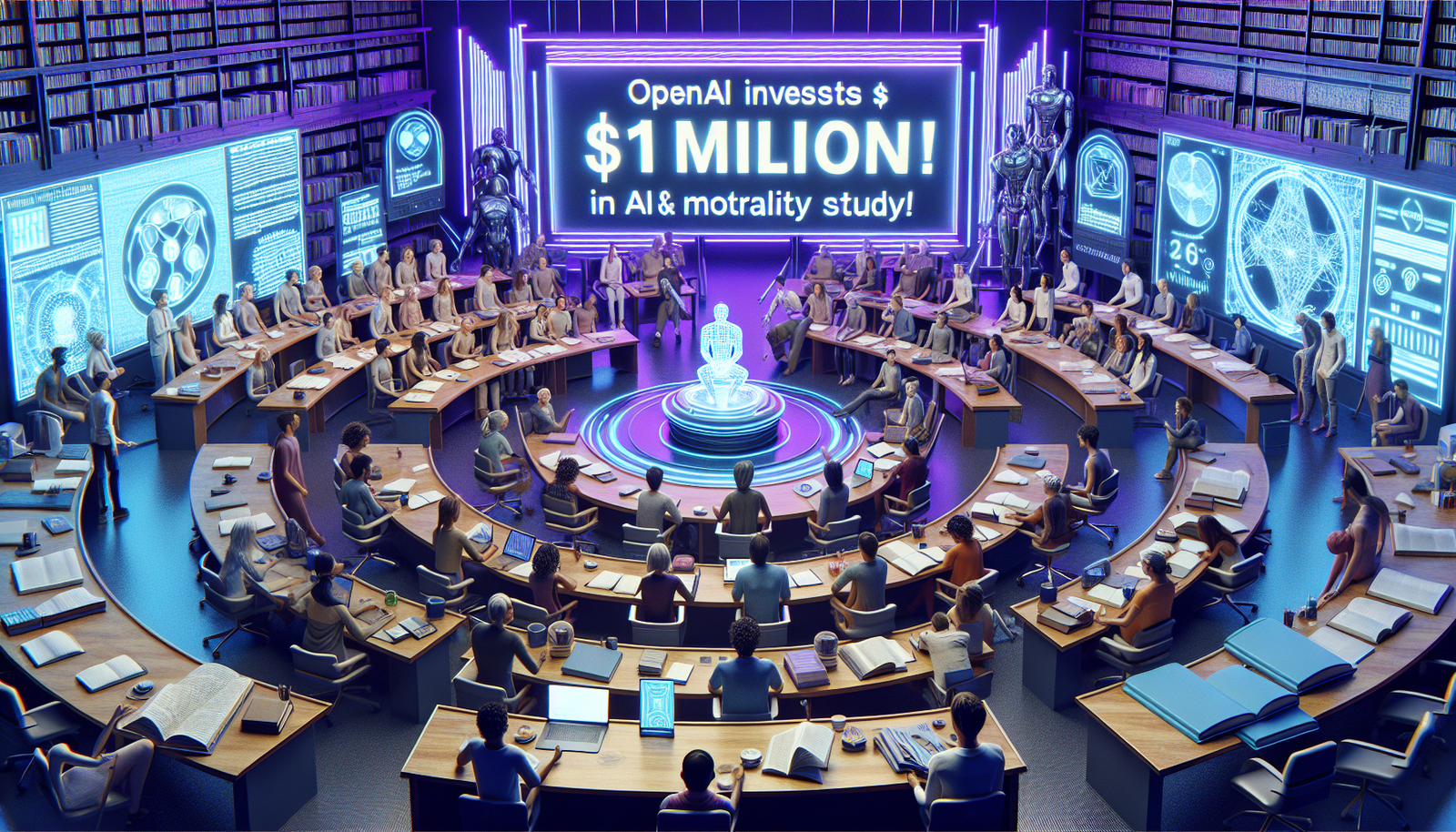
OpenAI invests 1 million dollars in a groundbreaking study on artificial intelligence and morality at Duke University. This initiative *reveals the growing tensions* between advanced technology and ethical decisions. The interaction between algorithms and moral judgments sparks intense debates, questioning the limits of AI. *How much* can it understand and manipulate human morality? *The stakes are high*: can we really entrust AI with complex ethical decisions? The research pursued by Duke, under the guidance of ethics experts, aims to question *the trust we place* in these intelligent technologies.
OpenAI and Duke University: a significant partnership
OpenAI has decided to allocate a 1 million dollar grant to a research team at Duke University. This initiative is part of a willingness to explore how artificial intelligence (AI) can understand and predict human moral judgments. The grant highlights the intersection of technology and ethics, an increasingly crucial area in the development of advanced AI systems.
The “Making Moral AI” project
The project has been entrusted to the Moral Attitudes and Decisions Laboratory (MADLAB) at Duke University, led by ethics professor Walter Sinnott-Armstrong. The aim of this research is to create a prototype of a “moral GPS”, a tool capable of guiding individuals in their ethical decisions through sophisticated algorithms.
The work conducted by the team integrates various fields, including computer science, philosophy, psychology, and neuroscience. This holistic approach aims to develop a deep understanding of moral attitudes and decision-making processes.
The role of AI in morality
MADLAB is examining AI’s ability to predict or influence moral judgments. For example, an algorithm could evaluate ethical dilemmas related to autonomous vehicles or provide advice on responsible business practices. These situations raise fundamental questions about the development of the moral framework that guides these tools.
Ethics and decision-making
The research also sheds light on the issue of trust placed in AI for decisions with ethical implications. The question of who determines the moral framework behind these applications remains essential.
OpenAI’s vision
OpenAI’s financial support aids the development of systems capable of predicting moral judgments in various fields such as medicine, law, and business. In these sectors, ethical stakes are often complex and nuanced. Although AI presents significant potential, it still struggles to grasp the emotional and cultural subtleties inherent in morality.
The challenges of integrating ethics
Integrating ethics into AI systems poses considerable challenges. Morality is not universal; it varies by cultural and social contexts, making it difficult to incorporate into algorithms. Furthermore, the lack of transparency and accountability mechanisms could lead to reinforcing biases or favoring harmful applications.
Future implications
OpenAI’s support for this research at Duke University represents a step toward a better understanding of AI and its role in ethical decision-making processes. Developers and lawmakers must collaborate to ensure that AI tools align with societal values while emphasizing equality and inclusivity.
The development of ethical AI applications requires particular attention to unintended consequences and systemic biases. Projects like “Making Moral AI” open avenues to navigate a complex landscape, seeking to combine technological innovation with societal responsibility.
AI can influence moral decisions. OpenAI shapes the ethics of artificial intelligences. An interdisciplinary collaboration is essential.
Frequently asked questions
What is the main objective of the study funded by OpenAI at Duke University?
The project aims to develop algorithms capable of predicting human moral judgments in various contexts while exploring how AI can influence or assist in ethical decisions.
Who leads the “Making Moral AI” project at Duke University?
The project is led by ethics professor Walter Sinnott-Armstrong, in collaboration with co-investigator Jana Schaich Borg.
What is the amount of the grant provided by OpenAI for this research?
OpenAI has granted 1 million dollars to fund this study on artificial intelligence and morality.
What academic fields are involved in this research project?
The project encompasses multiple fields, including computer science, philosophy, psychology, and neuroscience, in order to analyze how moral attitudes and decisions are formed.
How can AI be used to improve ethical decision-making?
AI could act as a “moral GPS”, guiding users through complex ethical dilemmas, for example, in autonomous situations or business practices.
What ethical challenges are raised by the use of AI for moral decision-making?
One of the main challenges is determining the moral framework that would guide these tools and the question of trust in ethical decisions made by AI.
Does this study have implications for the medical, legal, or business sectors?
Yes, the study examines how algorithms can predict moral judgments in fields such as medicine, law, and business, where complex ethical choices are frequent.
What role does OpenAI play in the development of ethical algorithms?
OpenAI is committed to funding and supporting research that explores the ethical responsibility of AI, ensuring that the tools developed are in line with societal values.
What are the concerns regarding biases in AI systems?
There are major concerns about how these systems may perpetuate existing biases, making it essential to incorporate transparency and fairness into their design.