


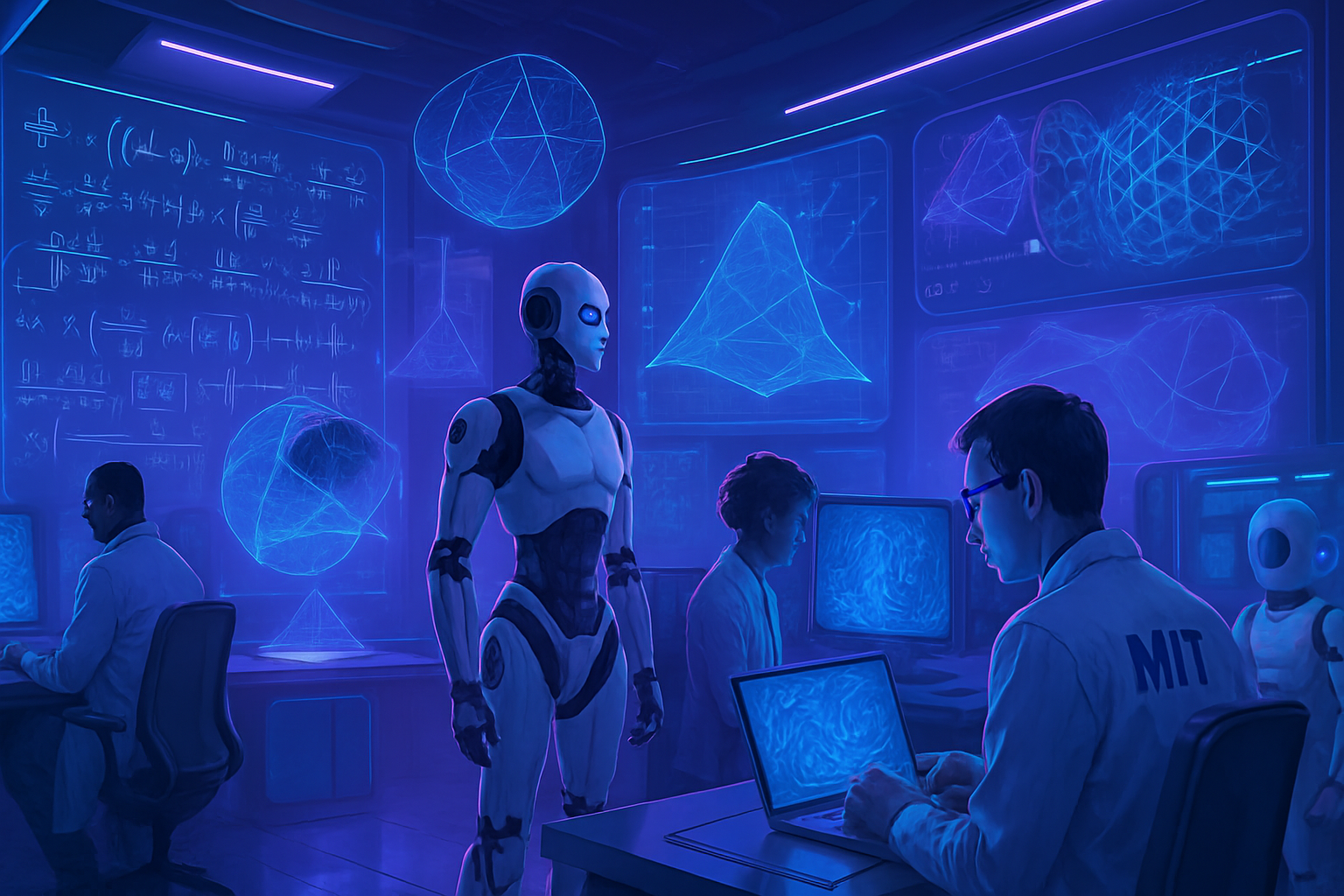
Researchers from MIT are revolutionizing the mathematical field through innovative AI grants. This ambitious initiative focuses on integrating artificial intelligence systems into mathematical discovery. Strategic projects herald revolutionary potential for the future of mathematics.
A bridge is being created between mathematical databases and formal tools. Their research promises to elevate the automation of theoretical proof to unprecedented levels. These advancements will explore the limits of mathematical knowledge, integrating informal results into rigorous verification systems.
MIT researchers receive AI grants to transform mathematical discovery
The researchers from the math department at MIT, David Roe and Andrew Sutherland, are among the first recipients of the AI for Math grants, offered by Renaissance Philanthropy in partnership with XTX Markets. Their project, alongside other initiatives led by alumni, aims to develop artificial intelligence systems that significantly advance mathematical discoveries and research.
Uniting LMFDB and mathlib
The funding awarded to Roe and Sutherland will be dedicated to enhancing the automated proof tool by linking the L-Functions and Modular Forms Database (LMFDB) to the mathematical library Lean4, commonly known as mathlib. Sutherland points out that automated proof tools are often under-resourced despite their technical commitment. With the rise of large-scale language models, the entry barrier for these formal tools is becoming lower.
The mathlib library, rich in content and community-oriented, aims to organize mathematical knowledge in the form of verifiable results. Within this library are approximately 105 mathematical results, ranging from lemmas to theorems. The LMFDB, on the other hand, represents a vast collaborative reservoir of modern number theory, containing over 109 concrete statements that aspire to be a living encyclopedia of the current state of knowledge.
An ambitious project for the future of mathematics
The project led by Roe and Sutherland aims to optimize both systems by making LMFDB results accessible in mathlib as unproven formal assertions. This interconnection will benefit both human mathematicians and AI agents, thus establishing a conducive framework for connecting other mathematical databases to formal proof systems.
The major obstacles to automating mathematical discovery present considerable challenges. Between the limited quantity of formalized knowledge and the high cost of formalizing complex results, the search for a viable path requires smart investment. The researchers emphasize that it is essential to design tools facilitating access to LMFDB from mathlib, enabling a body of knowledge to be formalized effectively without needing to formalize everything beforehand.
The benefits of a structured approach
Making a vast database of non-formalized mathematical knowledge available within mathlib will prove to be a powerful technique for mathematical discovery. Roe observes that the potential for exploring theorems or proofs becomes exponentially greater when agents can access a larger number of facts while not being limited to those that are formalized.
Innovative theorems, often at the intersection of sharp mathematical knowledge, require the execution of non-trivial calculations. For example, the proof of Fermat’s Last Theorem by Andrew Wiles illustrates this reality, requiring deep knowledge and modern computational tools. Although mathematical proofs can be complex, the integration of formal computational systems with mathematical databases presents numerous notable advantages.
Future perspectives and community commitments
Their next steps involve working closely with the communities of LMFDB and mathlib. They aim to formalize essential definitions concerning elliptic curves, number fields, and modular forms present in the LMFDB. This process will begin with the implementation of LMFDB research from within mathlib.
Roe invites MIT students interested in participating in this dynamic to get in touch. The development of these mathematical tools represents a renewed hope for opportunities offered by new technologies, instilling a promising momentum for the future of mathematical research.
User FAQ: AI Grants for Mathematical Discovery at MIT
What are the main achievements of MIT researchers thanks to AI grants?
MIT researchers David Roe and Andrew Sutherland have received grants to develop AI systems aimed at improving the automatic proof of theorems and establishing connections between mathematical databases.
How will AI grants impact mathematical research?
These grants will accelerate the process of mathematical discovery by making a vast database of non-formalized mathematical knowledge accessible, thus facilitating the identification of new theorems.
What databases will be used in these research projects?
The projects will primarily rely on the L-functions and Modular Forms Database (LMFDB) and the Mathlib mathematical library, which contain mathematical results and formal definitions.
How do researchers plan to overcome obstacles to formalizing mathematical discoveries?
They will develop tools to access the LMFDB from Mathlib, thereby making a large amount of mathematical knowledge accessible to formal proof systems.
What is the role of proof assistants in this project?
Proof assistants will use the non-formalized data from the LMFDB to target specific subjects for formalization, streamlining the process of validating theorems.
Why is it important to integrate AI tools into mathematics research?
The integration of AI tools lowers the entry barrier for using formal systems and significantly improves the efficiency of research in complex mathematics.
What challenges will researchers need to overcome when using AI in mathematics?
The main challenges include generalizing results, the complex formalization of data, and maintaining a clear separation between accessible data and those that can be formalized.
What is the anticipated impact of this project on the mathematical community?
This project aims to create synergies between mathematicians and AI agents, thus promoting new mathematical discoveries and enriching the existing knowledge base.
When should this research begin and what is its expected duration?
The research will start soon, with short, medium, and long-term development stages to strengthen the tools and databases.