

Catastrophic events paralyze infrastructures, pushing humanity to seek quick and effective solutions. Advanced technologies, such as AI-guided drones, are emerging to tackle unprecedented challenges. These innovative flying devices rely on 3D printing to erect structures in inaccessible areas. This revolutionary approach, combining precision and speed, could redefine our relationship with construction in hostile environments. Autonomous assembly systems and linguistic models enhance the resilience of operations in critical situations while overcoming obstacles that hinder the delivery of aid.
AI-guided Drones
Significant advancements in technology provide innovative solutions in the face of disasters. In emergencies, when roads become impassable, autonomous drones take the lead. These devices, equipped with artificial intelligence, have been designed to transport materials and erect temporary structures, thus ensuring shelters for those in distress.
Emerging Aerial Additive Manufacturing Technology
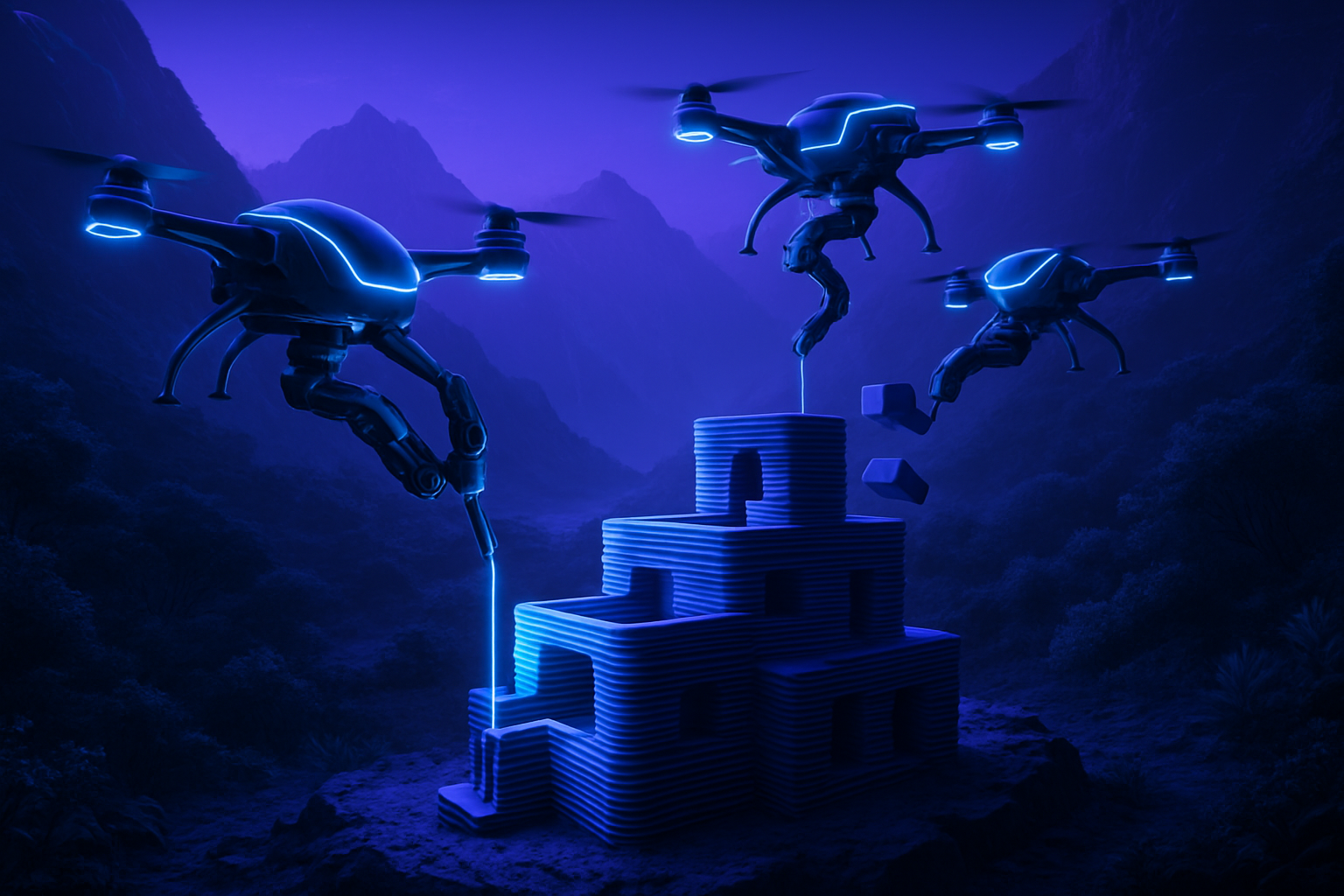
The combination of drones and additive manufacturing paves the way for a new era of aerial construction. Researchers at Carnegie Mellon University have developed an innovative system capable of transforming abstract design goals into executable plans. These drones, referred to as “flying printers“, can construct complex structures while maintaining stability through integrated magnetic blocks.
Collaboration Between Engineering and Artificial Intelligence
Amir Barati Farimani, an associate professor of mechanical engineering, has led this research. With a large base of linguistic models, the construction process adapts to real-time challenges. Drones can generate and modify plans directly on-site, allowing for a rapid response to unforeseen circumstances. This flexibility promotes efficient and precise construction, even in a dynamic environment.
Encouraging Tests and Results
The progress of the trials was marked by the establishment of a 5×5 grid on which the drones were to perform specific constructions. Thanks to camera monitoring, each error at any given moment leads to an instant adaptation of the instructions. The results are impressive: a construction success rate of 90% was achieved due to this closed-loop feedback.
Potential Applications and Future of the Technology
The practical applications of this technology go beyond mere disaster response. Drones could prove valuable for filling potholes, repairing devices in orbit, or constructing infrastructure in mountainous areas inaccessible to heavy machinery. The adaptability potential of drones could transform hard-to-reach areas into safe and livable spaces.
Toward Real-World Deployment
Researchers are now considering outdoor tests to tackle concrete challenges. An exploration of using more dynamic construction materials is on the agenda to optimize design yields. The future of aerial construction could be shaped by drones integrating more adaptable materials, thus offering improved performance in varied environments.
To learn more about these technological advancements, check articles related to drone innovations, such as those from Swift Competition and Anduril. Discussions surrounding artificial intelligence continue to evolve, particularly the debate on the arms race in technology, as highlighted by LIA.
Emerging technologies, such as those implemented by a British startup like DIA, enhance interest in military drones and their practical use. Finally, events like VivaTech 2025 clearly demonstrate the importance of artificial intelligence in future technologies.
User FAQ
How do AI-guided drones work for construction in inaccessible areas?
Drones use 3D printing systems, combined with magnetic blocks to assemble structures with precision. They are equipped with language models capable of translating design goals into actionable plans.
What types of structures can these drones build?
These drones can construct various types of structures, including temporary shelters, bridges, and infrastructure repairs, adapting to the specific needs of each situation.
What is the accuracy of the construction performed by the drones?
Construction is successful at a rate of 90% due to a closed feedback system that allows drones to correct errors in real-time, without having to restart the process.
Can drones operate in harsh weather conditions?
While drones are designed for flexibility, their operation may be affected by extreme weather conditions. Tests will be conducted to evaluate their performance in these scenarios.
How do drones manage unforeseen issues during construction?
Drones utilize language models to adjust construction plans in the event of a problem, allowing for on-site adaptation to ensure efficiency and accuracy.
What materials can be used for 3D printing with these drones?
Drones are currently being tested with various materials, and the research team is considering exploring the use of more dynamic materials to further optimize the flexibility of construction designs.
What is the role of artificial intelligence in this process?
Artificial intelligence, particularly through the use of language models, allows drones to autonomously plan and execute complex constructions, thereby increasing their efficiency in difficult-to-access environments.
Can drones be used for rescue missions after a disaster?
Yes, these drones are designed to be quickly deployed after a disaster, providing shelters and restoring essential infrastructure to reconnect people to safe areas.
Is it possible to use these drones in urban or densely populated areas?
This depends on local regulations and flight conditions. However, the team is exploring this possibility for diverse applications in urban landscapes.
What is the construction duration of a structure with these drones?
The duration varies based on the complexity of the structure, but the use of 3D printing and real-time correction systems significantly speeds up the construction process.