

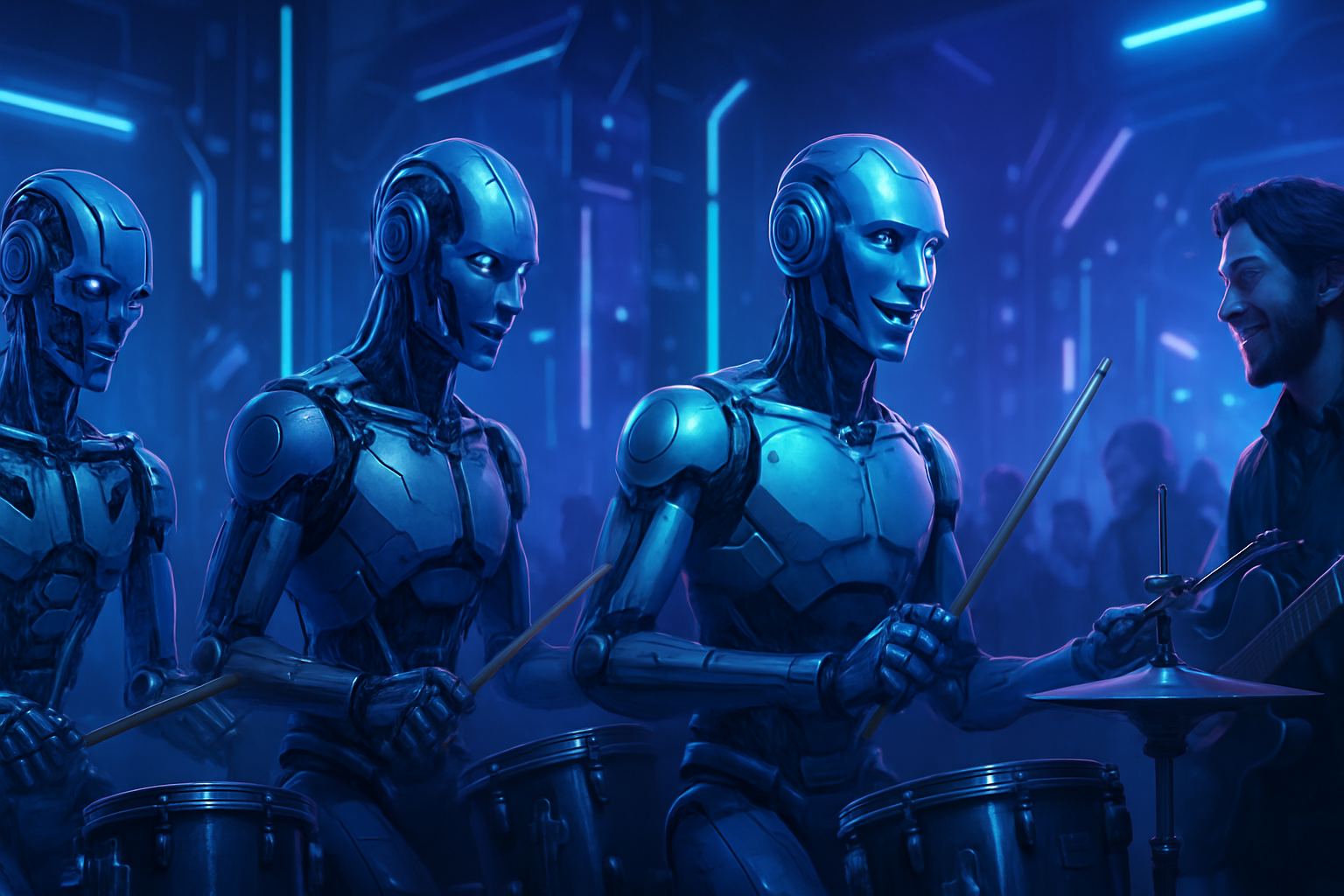
The emergence of the robotic drummer is generating growing interest, reinventing the creative norms of music. *The gradual acquisition of human-like behaviors* opens fascinating perspectives on artificial intelligence, enriching the artistic expression potential of machines. *The integration of machine learning* in this discipline allows the robot to imitate the finesse of seasoned percussionists. *The harmony between technology and creativity* is just beginning its dizzying ascent.
The Development of the Robot Drummer
Researchers from SUPSI, IDSIA, and the Politecnico di Milano have unveiled an innovative project: the Robot Drummer. This humanoid robot is capable of playing drums with remarkable precision and expressiveness, thanks to a reinforcement learning algorithm. Its success is the result of a quest to go beyond the usual manual tasks of robots, venturing into creative domains.
Emerging Human-Like Behaviors
The Robot Drummer stands out for its ability to gradually acquire behaviors similar to those of human drummers. Relying on a chain of rhythmic contacts, it receives instructions on when and how to hit the drums. This process allows it to train in a simulated environment, where it perfects its movements to achieve this rhythmic harmony.
An Innovative Artistic Performance
Researchers have tested this technology on Unitree’s G1 robot, teaching it to play iconic pieces ranging from jazz to rock, such as “In the End” by Linkin Park. The performances revealed a rhythmic accuracy exceeding 90%, demonstrating the robot’s ability to tackle complex rhythmic structures. This endeavor marks a significant advancement towards a more authentic interaction between machines and performing arts.
Learning and Improvisation Strategies
Other behaviors similar to those of humans have been observed. The robot was able to plan its strikes, execute cross hits, and readjust its sticks in real-time. These behaviors emerged naturally, revealing optimization strategies to maximize the rhythmic rewards obtained during training. Such a capability could transform the future of musical performances by integrating robots into live bands.
Future Prospects for Musical Robotics
The work surrounding the Robot Drummer could inspire other research teams to develop similar tools, thus enriching the landscape of musical robotics. The introduction of musician robots like the Robot Drummer could also have significant implications for the entertainment industry. Future intentions include acclimating the skills acquired by the robot to real devices, allowing for adaptive musical responses.
A Step Towards Artistic Autonomy
Future development focuses on improvisation. The team hopes to teach the Robot Drummer to adapt its playing style based on musical cues, allowing it to feel and respond like a human drummer. Such an advancement would open opportunities for dynamic interaction with musicians on stage, making the performance even more captivating.
To learn more about this research, you can check additional articles at this link and this one.
Frequently Asked Questions about the Robotic Drummer and its Human Behaviors
What is a robotic drummer and how does it learn to play?
A robotic drummer is a humanoid device capable of playing drums using machine learning algorithms. It learns to play based on rhythmic sequences and optimizes its movements through simulations.
How does the robotic drummer imitate human behaviors?
The robotic drummer gradually develops behaviors similar to those of humans by learning to anticipate strikes, adjust its gestures to reach different drums, and modify its playing style according to the rhythm of the music.
What types of music can the robotic drummer play?
The robotic drummer can play pieces from various musical genres, ranging from jazz to rock and metal, reproducing popular songs with great rhythmic precision.
What is the importance of reinforcement learning for the development of the robotic drummer?
Reinforcement learning allows the robotic drummer to receive rewards based on its performances, which encourages it to improve its rhythmic skills and learn new playing strategies.
Can the robotic drummer improvise music like a human musician?
While the robotic drummer is programmed to play specific pieces, future research aims to enable it to improvise and adapt its playing style based on musical cues, thereby mimicking the capabilities of a human drummer.
What advancements can be expected from the robotic drummer in the music industry?
The development of robotic drummers could revolutionize the music industry by offering performances accompanied by robots in live concerts, and opening up opportunities for innovation in the use of robots as musicians.
What are the current limitations of robotic drummers compared to human drummers?
Some limitations of robotic drummers include their limited improvisation ability, understanding of musical emotions, and dependence on predefined algorithms for playing, making them less adaptable than human musicians.