

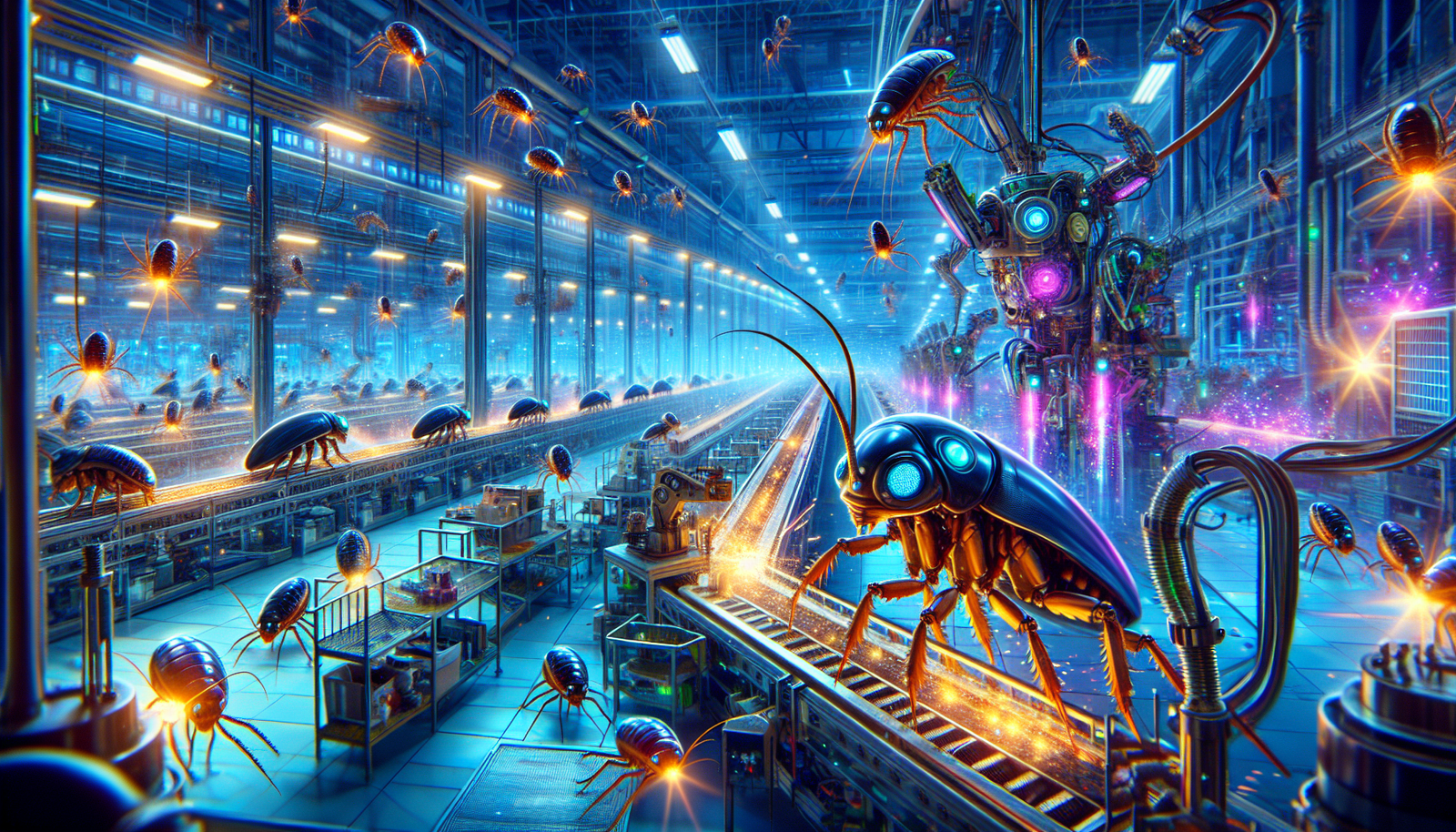
Recent technological advancements open fascinating prospects for the hybridization of biology and electronics. *A cyborg cockroach factory* aims to reinvent robotics with innovative solutions. The automated assembly process, designed by engineers, promises fast and efficient manufacturing of these hybrid beings, crucial for various missions.
This technological feat relies on a refined automation system capable of linking electronics and living insects. Reducing the time required for assembly proves essential to developing armies of cyborgs capable of search and rescue missions. The ethical and practical implications of these innovations deserve particular attention, as they disrupt the traditional boundaries of robotics and biotechnology.
An advancement in cyborg automation
A team of mechanical engineers, affiliated with Nanyang Technological University in Singapore, has achieved a revolutionary innovation. They have automated the assembly process of living cockroaches and electronic equipment, thus creating cyborg cockroaches at an unprecedented rate. Their study, published on the preprint arXiv, demonstrates an effective method for linking electronic components to living insects.
Optimization of the linking process
Previous research had proven the feasibility of connecting electronics to living insects, allowing for remote control without causing injury. The system used consists of a small device, often presented in the form of a backpack, containing communication and stimulation elements. This mechanism stimulates the antennae, thus directing the cockroach towards specific directions.
The major challenge lay in the duration and precision of the linking process. Similar projects require, on average, nearly thirty minutes to establish this contact. This excessive time proved a barrier to creating usable armies of cyborg cockroaches for operational missions.
Innovative automated system
In this new research, scientists have developed a system capable of reducing this time. By first exposing the cockroaches to carbon dioxide, the insects are plunged into a temporary state of hypnosis. Subsequently, a sophisticated device keeps the cockroaches immobilized using metal rods, thus providing secure access to the body parts required for assembly.
A preprogrammed computer vision system determines the ideal position for the electronics. The data collected is then transmitted to a robotic arm that has previously received specific training to manipulate the necessary components with precision. Finally, the rods are withdrawn, allowing the cockroach to regain its freedom after assembly.
Performance and efficiency of the system
The results obtained are impressive: each cyborg cockroach can be produced in just 68 seconds. Tests have confirmed that these cyborgs function equivalently to manually assembled insects, with no performance loss observed.
Outlook for the future of cyborg cockroaches
Researchers are considering the next step of their project: to make these cyborgs autonomous. Currently, simultaneous control of a large number of such insects remains unfeasible. Their goal is to develop systems allowing for collective direction, aiming to optimize the use of these swarms of cyborgs.
This technological advancement opens fascinating perspectives in the field of industrial automation and in potential future applications, particularly for search and rescue missions or environmental monitoring tasks.
Frequently asked questions
What is a cyborg cockroach factory?
A cyborg cockroach factory is an automated system that combines living cockroaches with electronic components, allowing the creation of hybrid robots that can be controlled remotely.
How does the process of creating cyborg cockroaches work?
The process begins by putting the cockroaches to sleep using carbon dioxide. Then, a robotic arm equipped with an automated vision system attaches the electronic components to the insects.
What is the time needed to create a cyborg cockroach?
The automated system allows for the production of a cyborg cockroach every 68 seconds, which represents a significant reduction compared to the manual process that took about 30 minutes.
What are the advantages of using cyborg cockroaches in specific missions?
Cyborg cockroaches can be used in search and rescue contexts due to their size, agility, and ability to access confined areas, all while being controlled remotely.
Are the cockroaches injured during the assembly process?
No, the assembly process is designed not to harm the cockroaches. The components are attached in a way that does not cause pain or injury to the insects.
What types of tasks can be performed by cyborg cockroaches?
Cyborg cockroaches can be used for surveillance missions, terrain mapping, or substance detection using the sensors mounted on them.
Is the technology to create cyborg cockroaches available for other types of insects?
While this technology has been developed primarily for cockroaches, research is underway to adapt these methods to other insect species.
What are the current challenges regarding the autonomy of cyborg cockroaches?
Currently, directing a large number of cyborg cockroaches simultaneously is challenging. Researchers are working on systems that would enable these insects to be more autonomous and capable of acting without constant human intervention.